
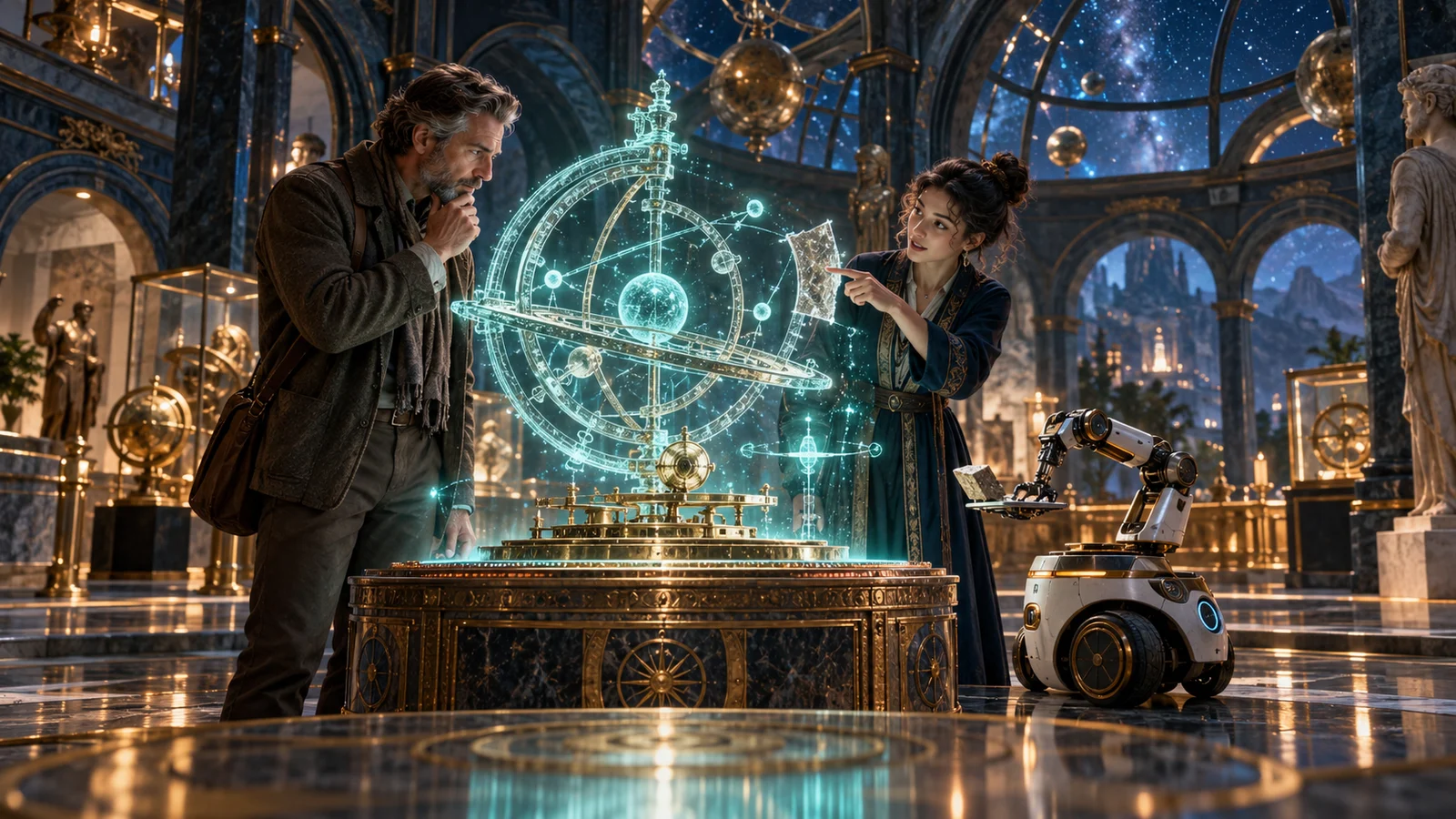
QUANIA · Future Scenarios Laboratory
Utopia Horizon
Change one condition. Trace the outcome.
How could a fairer world work? Consider water, work, knowledge and decision-making together. Here QUANIA is a shared design inquiry: consulting evidence, testing alternatives and making our mistakes visible.
Explore a city’s water supply in 2076 and how people work with AI in 2126. Test phase in a two-qubit circuit, then investigate the source of a radio trace at the observatory.

A coast where waves, wind, storage and maintenance are considered together. This scene opens a design question about sharing energy in the future.
Artistic fiction created for QUANIA · not a historical document or an existing future.Open the other scenes in this room

A city’s water, work and decisions belong to the same shared life. Designing together begins by listening to one another’s needs.
Artistic fiction created for QUANIA · not a historical document or an existing future.
A future scene of water recovery, replaceable parts and accessible transport. Systems that need to work together are seen within one shared life.
Artistic fiction created for QUANIA · not a historical document or an existing future.Scenario diagram and its limits
QUANIA · Designing a shared world
Imagine a city. Then give it a difficult day.
Every design can look good when resources are abundant. What happens when water runs short, power fails, care teams shrink or a decision is challenged? Change an assumption and examine the benefit, the gap and who is left waiting.
Every number is a fictional input chosen for this workshop. Results follow the equations shown below; they are not real city data, forecasts, clinical capacity or justice scores.
Preparing the model…
Assumptions you can change
Access to water
Two districts share one source. Does allocating equal amounts produce the same result as allocating by need?
Results under these assumptions
Access to water
A ↔ B- Total demand met
- A · Pinned17,280B · Now17,280B − A+0
- Reserve retained
- A · Pinned1,920B · Now1,920B − A+0
- Unmet demand in district A
- A · Pinned1,632B · Now1,632B − A+0
- Unmet demand in district B
- A · Pinned1,088B · Now1,088B − A+0
units/day
units/day
units/day
units/day
Using the reserve can close today’s gap while reducing tomorrow’s buffer. This model does not establish a safe reserve or each household’s actual needs.
Open the calculation
District A needs 12,000 and B needs 8,000 units/day. Net water = inflow × (1 − loss/100). Reserve = net water × reserve/100. The rest follows the selected rule, capped at each district’s demand. Any unused water is accounted for separately.
Holographic light show
Rehearsing the future
The route water takes
In the 2076 scenario, light carries water towards a coastal city. Which district gets it first depends on decisions made along the way.
Possibility Table · 01
Who will safeguard the city’s water in 2076?
After a dry spell, a coastal city invests in its water system. Try two decisions under the same conditions. What might the city gain by reducing water losses or by producing fresh water from the sea?
This is a thought experiment. The results show how your assumptions affect the trade-offs. Capacity, costs and probabilities would require local data.
Shared conditions
What each decision changes
Repair the network
Measure water losses. Prioritise pipes with the worst leaks and neighbourhoods with the poorest service.
- Water supply
- Water saved through repairs can provide a buffer during one dry season.
- Energy and operations
- The existing pumps keep running. Leak detection, pipe repairs and ongoing maintenance shape the workload.
- Household access
- Prioritising underserved neighbourhoods can improve basic access alongside system-wide repairs.
What observation would change your decision?
Reconsider if measured leakage is smaller than expected or rises again after repairs.
Add a source from the sea
Use reverse osmosis to desalinate seawater. Plan for power and the concentrated brine that remains.
- Water supply
- An operating plant can supplement rainfall-dependent sources. Build time and operating capacity matter.
- Energy and operations
- High-pressure pumps and membrane upkeep carry recurring costs. Discharge requires marine monitoring.
- Household access
- A basic supply guarantee and tariff support can help the new source reach low-income households.
What observation would change your decision?
Reconsider if outage logs, measured power use or marine monitoring exceed the design assumptions.
Decision Traces · 02
How do you learn a profession in 2126?
In a fictional city office, an AI system reads requests for services and proposes a decision. Compare two ways of handling the same request. In one, the system processes routine cases. In the other, a staff member reviews the file before a decision.
This is a thought experiment set in 2126. Today’s studies measure particular workplaces and tasks. They do not determine future jobs or the size of these effects.
Shared conditions
What each workflow changes
Automate routine decisions
The system decides routine cases. Staff handle exceptions and audit a sample afterwards.
- Learning the profession
- Supervised practice lets new staff try basic tasks usually handled by the system.
- Errors and service time
- Staff can audit sample decisions afterwards. An error can already affect someone before it is detected.
- Appeals and accountability
- A person can reach a reviewer outside the automated workflow that made the decision.
What observation would change your decision?
Include repeat requests and corrected decisions. If total resolution time stays the same, the first response is an incomplete measure.
Review before deciding
The system proposes a decision. A staff member checks the evidence and records a reasoned decision.
- Learning the profession
- New staff can compare the recommendation with the record and discuss its reasoning with a colleague.
- Errors and service time
- Someone who can check the source can change the recommendation before it affects the service decision.
- Appeals and accountability
- A second reviewer can compare the original reasoning with new evidence from the applicant.
What observation would change your decision?
If longer review catches fewer errors in sample cases, investigate which part of the review is failing.
Quantum Laboratory · 03
Same odds, different phase
Two qubits start in the zero state. Choose an experiment or add gates in order. Then measure along Z, X or Y. Compare which results are possible with how often they appear in a set of trials.
An ideal quantum circuit simulated on a classical browser. The model uses neither a physical quantum processor nor device noise.
What do the gates do?
- H
- Starting from |0⟩ or |1⟩, it makes the two Z outcomes equally likely. Applying H again undoes it.
- X
- Swaps the |0⟩ and |1⟩ states.
- Z
- Flips the sign of the |1⟩ component.
- S
- Adds a quarter turn to the phase of the |1⟩ component.
- T
- Adds an eighth of a turn to the phase of the |1⟩ component.
- CX
- Applies X to the other qubit in components where the control qubit is |1⟩.
Gate sequence
- Hq0
- Zq0
- Hq0
X 0Y 0Z -1
The vector describes q₀ alone. In this ideal two-qubit circuit, a shorter vector indicates entanglement with the other qubit.
Measurement results
Result order is q₀, q₁. Each trial prepares the same circuit from scratch. Counts can vary in a small sample.
| q₀q₁ | Probability | Count in 128 trials |
|---|---|---|
| 00 | 0% | — |
| 01 | 0% | — |
| 10 | 100% | — |
| 11 | 0% | — |
00 0% · 01 0% · 10 100% · 11 0%
Show the OpenQASM 3 circuit
OPENQASM 3.0;
include "stdgates.inc";
qubit[2] q;
bit[2] c;
h q[0];
z q[0];
h q[0];
c[1] = measure q[0];
c[0] = measure q[1];
Signal Room · 04
You found a trace. Where did it come from?
Three files await in the observatory archive. Point the telescope away, return to the target, then consult a second observatory. Find out which checks distinguish traces that look alike at first.
All readings in this room use synthetic training data. The exercise includes neither a real sky discovery nor a live telescope connection.
Records examined · 1/4
The first observation was taken with the telescope pointing at the chosen target.
Trace above threshold
- Initial frequency channel
- -23
- Channels per time step
- 0.375
- Width in channels
- 1
- Mean power along track
- 4.152
Colour represents relative power. The program searches frequency slopes, averages the power along a track and applies a threshold chosen for the synthetic data. That threshold carries no statistical confidence level for real telescope data.
Eight research paths · Close reading
A promising idea is only the beginning.
A future promise belongs beside the cost of building it. Each dossier moves from present evidence through design, objections, costs and a safe experiment. These are QUANIA’s research interpretations, not endorsements by the institutions cited.
Research proposal · No field trial conducted
One catchment, more than one voice
The capability sought for 2126 is water sharing supported by revisable responsibilities, not pipes alone. An upstream decision should not make a downstream district invisible; challenging a rule should not cost a community its basic service.
Open research dossier
Present foundations and the unresolved question
Research on common resources examines institutions beyond a single authority or firm. An example cannot simply be transferred to another catchment: flows, seasons, entitlements and power differ.
A route to implementation
- Record supply, loss, demand and measurement uncertainty separately. An average is not every household’s need.
- Run competing allocation rules against the same drought and fault record. Show the least-served group separately.
- Separate data correction, rule revision and independent appeal from the water operator.
- Any later pilot needs voluntary participation, a way to leave and protection of existing service.
The objection and a simpler option
Digital joint management may be costlier and more fragile than a working local agreement. Test whether repairs, an open allocation schedule and an in-person council solve the same problem.
Who bears which costs?
Meters require maintenance, calibration, power and interpretation. Participation takes time. Shifting costs to poorer users or unpaid community labour is not a success.
Failure, power and misuse
A faulty meter or under-reporting by a powerful user can distort allocation. Emptying reserves may please everyone today while concealing tomorrow’s gap. Correction needs a route that preserves basic service.
A first safe experiment
Compare the same daily budget for two fictional districts under three loss and reserve levels. Verify that delivered water, reserves, unused water and losses sum to inflow. Report today’s shortage separately from tomorrow’s buffer.
Which finding should change the idea?
Do not scale a more complex rule if missing measurements make it leave more people without water than a simpler allocation. Redesign a pilot that denies meaningful participation to the most affected group, even if aggregate efficiency rises.
What the sources actually support
Ostrom supports examining common-resource institutions at different scales. The OECD provides methods for testing alternatives rather than predicting one future. The catchment and calculation here are QUANIA’s fictional proposal.
Primary sources
Related original archive dossiers · Turkish: 22, 51
Change assumptions in the model ↑Research proposal · No field trial conducted
Districts that keep each other running
The capability sought for 2176 is staged recovery of energy, water and care after a central failure. The aim is continuity of essential services, not identical consumption in every building.
Open research dossier
Present foundations and the unresolved question
Storage, local generation and small grids are existing components. Our proposal does not claim to invent them; it studies service priorities, recovery and dependencies together.
A route to implementation
- Map the electricity, water and communication dependencies of each service.
- Prepare sequences of failures and recovery, not only one long outage.
- Design manual local operation and safe shutdown as carefully as automation.
- Require independent engineering review of each island’s reconnection conditions.
The objection and a simpler option
Insulation, efficient equipment and a reliable backup can be cheaper and more robust than a complex sharing network. Compare at the same critical-service level.
Who bears which costs?
Storage has costs beyond purchase: degradation, fire safety, parts, maintenance skills and disposal. Include the burden on the community on ordinary days too.
Failure, power and misuse
Apparently independent islands can fail together when they share one vendor or communication link. Storage readings can be wrong. Safe local operation should not depend entirely on remote permission.
A first safe experiment
Increase storage from zero for a fictional critical load, then change generation and outage duration. After checking conservation and unit conversion, add time-varying supply, power limits and starting loads in a separate model.
Which finding should change the idea?
Saving one district while cutting its neighbour’s critical load is not justified by total energy gains alone. A pilot should not proceed if local operators cannot take over safely.
What the sources actually support
DOE supports the storage-research context; NIST supports purpose-specific model validation. This workshop is not a real grid’s digital twin, a power-flow analysis or an electrical safety design.
Primary sources
Related original archive dossiers · Turkish: 13, 16, 27, 56
Change assumptions in the model ↑Research proposal · No field trial conducted
Making hidden care debt visible
For 2126 we seek the ability to notice fatigue accumulating behind service delivery. A community should see unprovided time and postponed needs, without turning a person into a unit of production.
Open research dossier
Present foundations and the unresolved question
The ILO studies paid and unpaid care in relation to work and social organisation. It does not provide a clinical measure of an individual’s required care hours. Our question is who absorbs the hidden burden when visible service grows.
A route to implementation
- Record demand, genuinely available staff time and unpaid family support separately.
- Do not delete coordination, training or rest under an inefficiency label.
- Include the person’s preferences and right to challenge, not staffing utilisation alone.
- Examine numerical gains alongside quality, continuity and burden shifting.
The objection and a simpler option
Staffing, transport support or simpler administration may outperform new software. Digital planning does not create missing labour.
Who bears which costs?
Make the costs of professional pay, training, travel, rest and coordination visible. Do not mark service complete when its gap has merely shifted to a family.
Failure, power and misuse
Rewarding easily counted visits may push complex needs to the back. Constant measurement can become surveillance of workers and recipients. Success metrics must not hide difficult cases.
A first safe experiment
Build a fictional weekly time budget without personal records. Compare the effect of staff absence and reduced coordination. Then explain why the resulting hours are not a quality measure.
Which finding should change the idea?
Redesign if the gap closes only through unpaid family labour. Faster service alone is not sufficient if personal choice or the care relationship deteriorates.
What the sources actually support
The ILO supports the economic and social context of care work. The hour model is QUANIA’s teaching assumption, not an individual care plan, a clinical staffing standard or institutional endorsement.
Primary sources
Related original archive dossiers · Turkish: 28, 61, 65
Change assumptions in the model ↑Research proposal · No field trial conducted
Oversight that is itself accountable
For 2176 we seek to distinguish independent oversight from moving a decision to another desk under the same power. Funding and authority links should be examinable; an appeal should not simply return to the original decision-maker.
Open research dossier
Present foundations and the unresolved question
Risk management and polycentric institutions offer ways to examine responsibility, monitoring and multiple decision centres. Appearing independent in a graph does not prove honesty or a correct decision.
A route to implementation
- Map the roles of decision-maker, funder, reviewer and appeal body.
- Test whether a dependency becomes hidden through intermediary institutions.
- Provide an accessible process outside the review for correcting links and challenging false accusations.
- Assess review quality, capacity and accountability separately.
The objection and a simpler option
Open reasons, separated duties and accessible human review may outperform an expensive decision network. Adding a blockchain or AI does not create independence.
Who bears which costs?
Expert reviewers, data verification, conflict declarations and free access to appeals require funding. Budget independence is fragile if the reviewed body can arbitrarily withhold the reviewer’s funding.
Failure, power and misuse
Missing records can hide dependencies; ordinary connections can generate unfair suspicion. Public complaint records can expose individuals to targeting. Transparency does not require publishing every personal file.
A first safe experiment
Use fictional institutions to create direct and indirect common-funding paths. Compare a path-search method with a direct-link-only check. Add erroneous records and insufficient independent staffing, keeping the backlog visible.
Which finding should change the idea?
Change the design if collecting more relationships violates privacy, presents innocent links as accusations or makes appeals inaccessible. Detecting a conflict and reviewing the substance correctly are separate acceptance tests.
What the sources actually support
NIST’s risk framework and Ostrom’s institutional work provide methodological context. The graph rule is QUANIA’s synthetic example, not a legal assessment of a real person or institution.
Primary sources
Related original archive dossiers · Turkish: 42, 46, 51, 53
Change assumptions in the model ↑Research proposal · No field trial conducted
Let the home change without uprooting a life
Imagine a home in 2126 that can adapt when a family, the climate or a resident’s mobility changes. A renewed façade should not become a reason to displace its residents. The capability we seek joins reusable building parts with the ability to remain in an affordable, familiar neighbourhood.
Open research dossier
A fictional day · Consider the design in a person’s life
A fictional day: The stairs in an apartment building have become a barrier for one resident. Should that person move away from friends, or can the shared space adapt? The success of the drawing is ultimately found in the person’s everyday life.
Present foundations and the unresolved question
UNEP and GlobalABC consider buildings’ climate effects, energy costs and housing affordability together. This does not establish the safety of any particular building system.
A route to implementation
- Treat the structure, adaptable partitions and services as separate layers. Record each part’s history, disassembly method and limits on reuse.
- Before drawing a new flat type, examine access, daylight, maintenance routes and temporary accommodation with users. Hear tenants and owners separately.
- Compare repair, adaptation and replacement over the same period of use. Include relocation, rent, lost work and later maintenance alongside materials.
- Plan for maintenance after a supplier leaves. Independent structural, fire-safety and accessibility reviews are separate conditions for any real implementation.
The objection and a simpler option
Homes may not need robotic shape-changing. A good ramp, cooler roof or repairable service installation may provide more value than a complicated moving structure. Preserving the existing building deserves an equally serious assessment.
Who bears which costs?
A cheap component can become an expensive dependency if it needs permanent specialist servicing. Show spare parts, training, rent effects and temporary accommodation alongside initial investment. Do not leave the poorest household with the bill for renewal.
Failure, power and misuse
An inaccurate material record may make a reused component appear safer than it is. A renovation praised for efficiency can raise rents and exclude former residents. Track building performance and residents’ ability to remain as separate outcomes.
A first safe experiment
Start on paper with three fictional households and one building. Use the same cost headings for repair, adaptation and rebuilding. Identify who gains access, who needs a temporary home and whose total burden rises. This exercise is not a structural calculation.
Which finding should change the idea?
Do not declare success when material savings increase maintenance burdens or make remaining in the neighbourhood harder. Reopen a design that cannot address users’ objections or depends on one supplier; an impressive energy score is not enough.
What the sources actually support
The source supplies present context on buildings, climate and affordability. The adaptable-neighbourhood proposal is QUANIA’s, not a tested building, a code-compliance assessment or a safe engineering design.
Primary sources
Research proposal · No field trial conducted
Keep the table supplied when a harvest is lost
For 2176 we seek a community’s ability to change its food supply together when a region loses a harvest or energy source. Seeds, production, storage, transport and income support belong at the same table. The aim is not to produce everything in one facility, but to prevent one failure from emptying every table.
Open research dossier
A fictional day · Consider the design in a person’s life
A fictional day: Power to a cold store fails while another region’s produce is delayed. Shelves remain full in one neighbourhood; in the next, households have no money for meals. The system has two distinct gaps: the availability of food and the ability to obtain it.
Present foundations and the unresolved question
FAO’s 2021 report considers diversity, connectivity and economic access in food systems together. Its historical figures are not presented as current hunger statistics.
A route to implementation
- Map water, energy, labour and transport dependencies from producer to table. Identify excessive dependence on one crop or supplier.
- Design different fallback routes for local production, outside supply and reserves. Two facilities on the same energy or transport link are not independent backups.
- Distinguish production shortages from income and access gaps. Consider nutritional needs, cultural preferences, transport and preparation facilities together.
- Independently assess the safety, energy burden and environmental effects of any new production method. Do not turn soil, water and waste limits into an invisible debt for the future.
The objection and a simpler option
Reducing loss, repairing storage, improving small producers’ transport or supporting incomes may outperform a new enclosed production facility. Locality and resilience are not identical; outside connections and local diversity each matter.
Who bears which costs?
A cheap product can conceal costly electricity, water, insecure labour or losses elsewhere. Make the financing of reserves, maintenance and access support explicit. Assess yield improvements alongside who can actually obtain a healthy diet.
Failure, power and misuse
Connecting all production to the same software, nutrient input or power line may amplify failure. A successful harvest does not automatically reach a household that has lost its income. Faster distribution cannot justify neglecting food safety or individual needs.
A first safe experiment
Without using real food, make supply cards for three fictional neighbourhoods. Remove one transport route, then the cold store. Track stocks, assumed spoilage, preparation facilities and household budgets in separate columns. Record gaps that can be closed without adding technology.
Which finding should change the idea?
Change a fallback design that works only by consuming more energy or keeping food among those who can pay most. Retest resilience claims when short-term abundance erodes water, soil or another community’s livelihood.
What the sources actually support
FAO supplies a framework for examining present systems. The 2176 food network is QUANIA’s fictional design research, not an implemented nutrition programme, a safe food-production recipe or a prediction of an actual famine.
Primary sources
Research proposal · No field trial conducted
Leave room for thinking, not just an answer
A school in 2126 should preserve the right to learn and the provenance of knowledge as its tools change. A disconnected child should not be left behind; an adult revisiting a qualification should not have to surrender a lifetime of data. The capability we seek is support without continuous tracking.
Open research dossier
A fictional day · Consider the design in a person’s life
A fictional day: A student solves the same problem by two routes. The system marks an unfamiliar route as failure. A teacher examines it again: the flaw lies in the assessment rule, not the student. That correction should remain visible for later learners.
Present foundations and the unresolved question
UNESCO’s guidance on generative AI emphasises human agency, data privacy and pedagogical evaluation in education. It does not prove that a particular tool improves learning.
A route to implementation
- Version each learning unit with its source, explanation, example and testable aim. Corrections should show which material changed.
- Provide offline material, compatibility with assistive tools and a teacher-led route. Fast connections and new devices should not be prerequisites.
- Do not measure success only through time, clicks or correct answers. Let learners explain their reasoning and challenge an assessment.
- Keep the necessary part of learning history portable under the person’s control when tools change. Prefer teacher-supervised transitions that do not require a complete behavioural archive.
The objection and a simpler option
A well-prepared human explanation, accessible book or small group may outperform a complex AI tool. If staff, time or transport are missing, do not assume software has supplied them.
Who bears which costs?
Budget teachers’ source checking, localisation, accessibility work, maintenance and correction time. Recalculate the total cost of a free tool that later creates dependence on data extraction or a costly subscription.
Failure, power and misuse
A polished voice can make a false explanation persuasive. More data does not automatically mean better understanding of a learner. Rankings and labels can narrow opportunities; a human route for correcting wrong assessments must remain open.
A first safe experiment
Without collecting children’s data, prepare two teaching drafts on one short topic for adult volunteers. Disconnect the network, test assistive access and later compare reasoning on a new question. Record satisfaction separately from learning, without announcing success in advance.
Which finding should change the idea?
Do not claim learning gains if greater use does not improve explanation and reasoning. Change a design that requires continuous tracking or one provider’s account for access. An automated judgment that a teacher cannot correct is not educational support.
What the sources actually support
UNESCO supports the ethical and pedagogical approach. QUANIA’s future-school proposal is not a tested teaching method. This page collects no learner profile and awards no learning score.
Primary sources
Related original archive dossiers · Turkish: 20, 29, 62, 63, 69
Research proposal · No field trial conducted
Let the same meaning arrive, not just the same word
For 2176 we seek to preserve necessary meaning across languages, sensory channels and broken connections. Imagine a shared needs layer that forces no one into a single language. Hazard, place, time, uncertainty and verified action remain distinct, and a person can ask about what they have not understood.
Open research dossier
A fictional day · Consider the design in a person’s life
A fictional drill: One person reads a screen, another hears audio, a third receives sign language. Delivery to all three does not show that they understood the same thing. The useful question is whether each can accurately explain the message in their own words.
Present foundations and the unresolved question
WMO describes CAP as a shared alert format usable across channels and languages. Technical compatibility does not demonstrate that everyone has understood a message.
A route to implementation
- Keep source, location, time, validity and uncertainty in distinct fields. Preserve the link between a correction and the older message.
- Review meaning separately with language, audio, visual and sign-language experts. Do not assume a symbol means the same thing in every culture.
- Plan local and human fallback routes when networks or devices fail. Test withdrawal of obsolete messages alongside delivery speed.
- When critical meaning is unclear, provide a route to authorised clarification rather than letting translation fill the gap by guessing. Checking understanding need not collect personal location histories.
The objection and a simpler option
A well-prepared multilingual notice, local guide or accessible printed sign may be more reliable than a complex translation network. Work on a shared language must not justify replacing existing languages or sign languages.
Who bears which costs?
Language specialists, sign-language expertise, local drills, device maintenance and version control need continuing labour. Lower costs in widely spoken languages do not justify permanently postponing less-resourced ones. Show the cost of shutting down or switching provider too.
Failure, power and misuse
Symbols can be interpreted differently; delayed messages can mislead despite accurate translation. Rapid delivery can amplify an unauthenticated error. Delivered, read and understood are separate outcomes.
A first safe experiment
Use only fictional cards clearly marked DRILL. Prepare one message in two languages and two presentation modes; ask volunteers to explain it in their own words. Add an expired card. Record errors of meaning, source and currency separately, without sending anything to real warning networks.
Which finding should change the idea?
Do not claim success when speed rises alongside misunderstanding. An average score cannot hide persistently worse results for a language or access mode. Redesign if personal tracking becomes a required price for understandable communication.
What the sources actually support
WMO supplies context on the existing alert format. The shared-meaning layer is QUANIA’s research proposal. This page issues no live alerts and gives no instructions for an actual emergency.
Primary sources
Related original archive dossiers · Turkish: 31, 33, 35, 37, 64
New close readings
What the scenarios rest on
Each dossier works through an example, a detail from the evidence and the limits of the conclusion it supports.
2076 · How do we read a water account?
A city may have abundant water over a year and still experience summer outages in some districts. Total supply does not tell us where or when people can access it.
Look closely at the evidence
Separate supply, leakage, demand and reserves for dry periods. Compare repairs and new capacity under one budget, then check the driest week and the least-served district.
What can we conclude?
The IPCC assesses observations and scenarios. QUANIA’s 2076 city is a worked example. A real city needs network and catchment data.
How could a district’s risk of running dry fall while the annual average stays unchanged?
Show the answer
Distribution and storage can change. A dry-period reserve or lower losses in the district can prevent outages without raising the annual total.
2126 · A task is different from a job
An occupation contains tasks affected in different ways by the same tool. Drafting a form may become faster. Explaining and correcting a wrong form can still take time.
Look closely at the evidence
The ILO study estimates exposure of tasks to generative AI. In your scenario, put tasks, decision authority and training needs in separate columns. Ask who gets the time that is saved.
What can we conclude?
Exposure does not predict job losses. Infrastructure, bargaining, organisational rules and the nature of the work can change outcomes.
If preparation speeds up but review takes longer, whose productivity has changed?
Show the answer
Preparation time can fall while the reviewer’s work grows. Measure total time, errors and correction effort across both tasks.
When do we rule out a signal?
BLC1 was a narrowband signal of interest observed in the direction of Proxima Centauri. An interesting pattern can warrant investigation before its source is known.
Look closely at the evidence
The team compared signals with similar features and the conditions in which they appeared. It concluded that BLC1 was consistent with terrestrial interference. Finding related features in other records mattered to the explanation.
What can we conclude?
This study explains why one candidate was ruled out. It does not settle the wider search. New candidates need to be examined on their own evidence.
What independent observation would you request to test a pattern seen once?
Show the answer
Ask to observe the same direction with a different receiver and compare with off-target recordings. An independent repeat makes a shared instrument fault less likely.
Research drafts
An open notebook for the future
Designing a world starts with asking who can live well, and under which conditions. These proposals consider basic needs, freedom and shared creation together.
50 initial projects · 17 new design directions · 3 extensions
These are proposals, not working products, implemented public systems or delivery promises. The proposed first experiments have not been conducted. 2126 and 2176 are research horizons, not deadlines. Sources support existing components and methods; they do not validate the complete QUANIA proposal.
The full research dossiers are currently available in Turkish. The four teaching labs and the close readings above are available in English.
Read the Turkish research originals